


About the Global Poker Index
Global Poker Index (GPI): A System for Ranking the World’s Best Poker Players
GPI: The Details
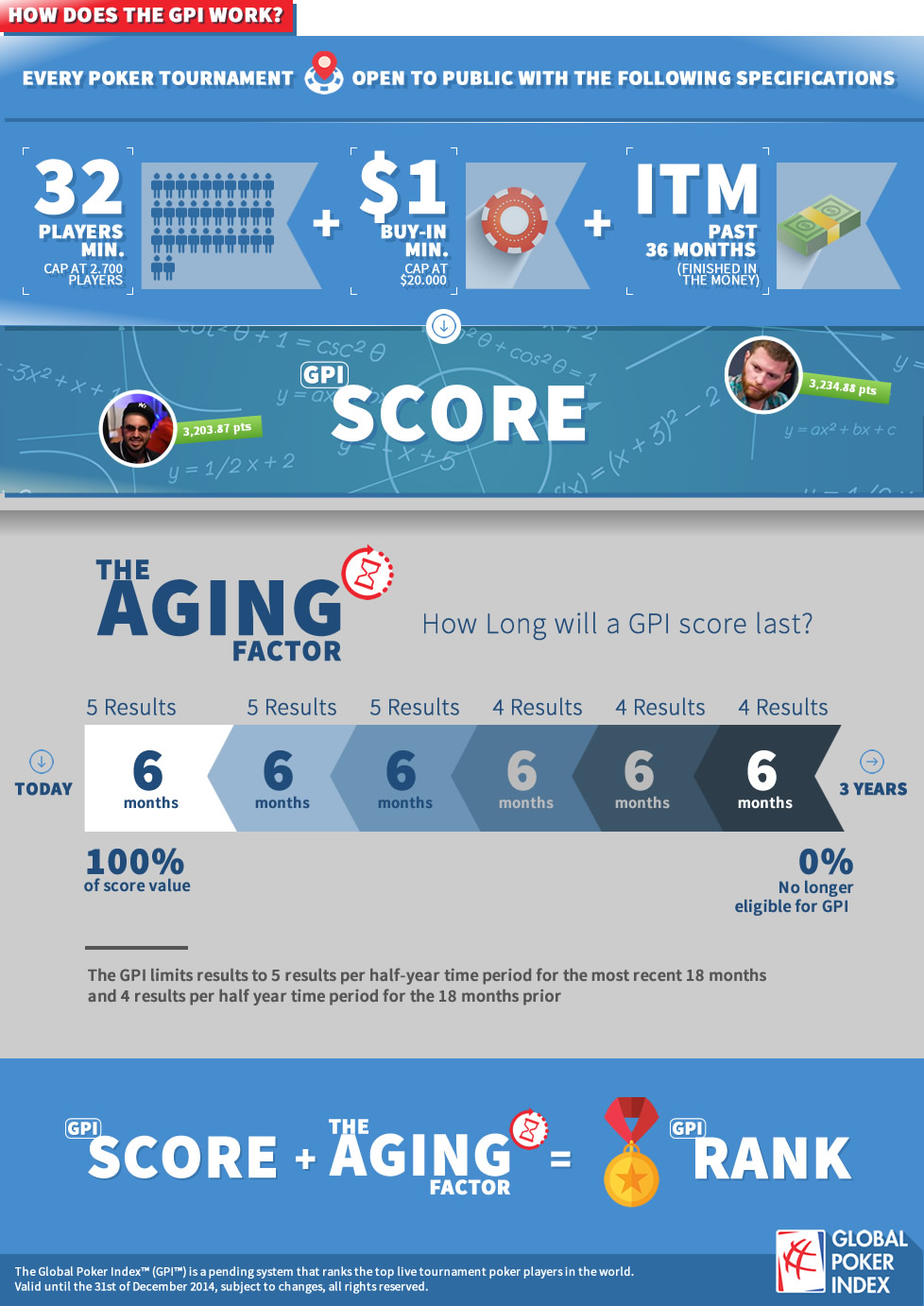
The Global Poker Index (“GPI”) is a ranking of the top 300 live tournament poker players in the world as of the day it is published. Players are ranked weekly based on their performance by finishing in cash positions in qualifying tournaments occurring over the previous 36 month period. A cash position is any position where the player receives a portion of the total prize for their performance in an event (all references to buy-in are inclusive of entry fees). Typically the top 10% to 20% of the participants in an event finish in a cash position. Qualifying tournaments are events with 21 or more players and a buy-in of $1500 USD (or other currency equivalent) or higher that are open to the public, and are not specialty or selected audience events such as charity, seniors, doubles, satellite, women, team, employee, executive and CEO events. Players are ranked according to their finishing scores in qualifying tournaments. Each player’s individual GPI score is an aggregate of scores in events over the previous 36 month period, measured from the day the GPI is calculated. The score for a given event is derived from a combination of their finishing place percentage, buy-in and aging factor. Finishing percentage refers to the percentage of the starting field a player bests in his or her finish. Buy-in refers to the relative amount of the event buy-in to the baseline buy-in of $1500 USD. Aging factor refers to the weighting of results by their recency, where more recent results are weighted more heavily than past results. The GPI limits results to four (4) results per half-year time period for the most recent 18 months and three (3) results per half-year period for the 18 months prior. The GPI aggregates only the top four scores per each half-year period in the most recent year and a half and the top three scores for the year and a half prior for a maximum total of 21 scores per 36 month aggregation period.
Finishing Percentage Factor
The GPI uniquely takes into account finishing place relative to total field size for an event. The GPI finishing score is expressed as the finishing position relative to field size of the tournament. The base finishing score is calculated as the percentage of the field that is bested by a given player. This means that the relative percentage change in base finishing score between any two places is different depending on number of entrants. The higher the number of entrants in an event, the smaller the percentage change between the base scores for, as an example, a first and second place finish. The lower the number of entrants for an event, the larger the percentage change in base score between a first and second place finish, or any other places in comparison to each other.
A field size cap is applied at roughly the 99th percentile of qualifying events to ensure that events with extremely large field sizes do not skew the overall GPI score. For any event with a field size larger than the field size cap, the field size cap is used to calculate the score rather than the actual field size number. Administration to determine the cap on field size is performed one time per year.
Buy-in factor
The next factor used in creating an individual event score is based on the buy-in for the event relative to the baseline buy-in for events, $1500 USD. This factor addresses the concept of relative difficulty for the event. Larger buy-in events presume that the difficulty of the field is greater because more elite players enter higher buy-in events.
The GPI takes into account the concept of diminishing returns on the buy-in to an event. The percentage increase in buy-in between a $1500 and $2000 event is much greater than the increase between a $20,000 and a $20,500 buy-in. The GPI seeks to capture this concept of diminishing returns by using a logarithmic function.
A buy-in cap is applied at roughly the 99th percentile of qualifying events to ensure extremely high buy-in events do not skew the overall GPI score. For any event with a buy-in larger than the buy-in cap, the buy-in cap is used to calculate the score rather than the actual buy-in amount. Administration to determine the cap on buy-ins is performed one time per year.
Aging Factor
The final factor used in calculating an individual event score is based on the age of the event, rewarding recent achievements while also allowing contribution for results over the 36-month period. Recent results are weighted more heavily since the GPI seeks to determine who the best live tournament poker player in the world is today. Best is defined by both consistency over time, which is why the ranking system looks over a 36-month period, and recent outstanding performance, which is why more recent results are weighted more heavily.
The GPI separates all results for a player into six distinct half year periods. Based on which half year period an individual result occurred in, the appropriate period-specific aging factor is applied. The aging factor is decreased for each half year period, giving more weight to recent events.
In the event a leap year occurs with the 36 month period, an additional day is applied to the smaller of the two half year periods in the 12 calendar months in which the leap year occurred.
Individual Event Score Calculation
To calculate an individual event score, the GPI program multiplies the Finishing Percentage Factor, the Buy-In Factor, and the Aging Factor. The product of this calculation is the GPI score for the given player in the given event.
Composite Score Calculation
The GPI composite score is the sum of all individual event scores. To help ensure that the GPI overall composite score is not skewed by instances of players performing in extremely large numbers of events, the GPI caps the number of individual event scores for each half year period. The number of events capped for any given half year period is determined by taking the mean number of finishes in live tournaments for the group of players that are in the GPI 300. Administration to determine the mean number of finishes is performed every six months. Once the mean number of finishes is determined, that is the cap for the number of individual scores that are counted for every half year period. For any player with more individual scores than the cap for the half year period, the highest individual event scores are calculated as part of the composite score, while the lower individual event scores are discarded. These discarded events may be later included in the composite score as they move from one half year period to the next.
GPI Ranking List
After all composite scores are calculated, players are ordinally ranked by their composite scores. The top 300 players are then included in the final GPI Ranking List for that week.
GPI: The Creators
The GPI was developed by Annie Duke, top poker professional and Commissioner of the Epic Poker™ League and Eric Faulkner, CIO of Federated Sports and Gaming, with support from Don Schlesinger, blackjack authority, financial consultant and lecturer, and Chief Strategy Officer of The Volatility Exchange.
Annie Duke is one of the leading personalities in professional poker today, Annie Duke brings her brand name to Federated Sports + Gaming as the company’s League Commissioner.
Since 1994 Annie has been dominating poker, quickly establishing herself as one of the best players in the world. In her very first tournament at the World Series of Poker, she placed 13th. Her first WSOP bracelet came in the $2000 buy-in Omaha Hi/Lo Split in 2004, which she followed up by knocking out nine poker legends to win the No-Limit Texas Hold’em invitation-only WSOP Tournament of Champions the same year. Along the way Annie has parlayed her skills into an industry-leading career that encompasses tournament play, advising gaming companies, authoring instructional books and videos, and as a proponent of players’ rights.
Prior to joining Federated, Annie was a consultant for the online poker site UB.com. Her role included developing promotions and poker professional endorsement strategy, as well as overseeing card-room management to ensure consistency with the rules and tournament structure of the quality of top poker rooms in the world. A longtime industry advocate, Annie has testified in front of the U.S. House of Representatives Judiciary Committee on Online Poker Legislation, the US House of Representatives Financial Services Committee and continues to be a leading voice for online gaming.
As an educator, Annie is sought after for her vast poker skills and knowledge and is a prolific producer of materials in a range of formats. She has created a series of celebrated DVDs, including:
- Annie Duke’s Advanced Texas Hold’em Secrets: How to Beat the Big Boys.
- Annie Duke’s Beginner’s Guide To Texas Hold ‘em.
- Annie Duke’s Girl’s Guide To Texas Hold ‘em.
- Masters of Poker: Annie Duke’s Conquering Online Poker.
Annie also wrote a notable autobiography, Annie Duke: How I raised, folded, bluffed, flirted, cursed and won millions at the World Series of Poker. Her newest venture, Decide to Play Great Poker, a poker strategy book, was released in Spring 2011. She is also an instructor at the World Series of Poker Academy.
Annie earned a double major in English and Psychology at Columbia University, and an MA in Cognitive Psychology from the University of Pennsylvania. She was also a National Science Foundation Fellow from 1988 to 1991.
Eric Faulkner is the Chief Information Officer (CIO) for Federated Sports + Gaming. He is charged with leading software development efforts, as well as management of all business information systems and supporting technology.
Eric served most recently as a consultant with Youbet.com, the largest independent, legal online gaming site in the U.S. until it was purchased by Churchill Downs Inc. (NASDAQ:CHDN) in June 2010. He was instrumental in leading the company’s efforts to revamp its software development and product development capabilities. Eric implemented numerous improvements to internal practices, driving higher, more consistent output of the technical departments and a more focused approach to the product development lifecycle. He also led the company’s exploration into expanding its gaming portfolio and extending its geographic footprint into Europe.
Prior to Youbet.com, Eric was Vice President of PMO (Project Management Office) and Quality Assurance at Network Solutions, the premier provider of web-based services,enabling small to medium sized companies to establish, design, maintain, promote and optimize their online presence. Eric led the PMO, the Product Development team and the Quality Assurance department, and coordinated all program management activities for the Software Engineering department. He instituted enhanced standards in the software development lifecycle process which led to materially higher degrees of quality and predictability.
Before Network Solutions, Eric was a Manager in Accenture’s technology consulting practice, overseeing a wide range of projects across a variety of companies, from small start-ups to Fortune 500 businesses. Eric’s focus areas were online sales channels and customer service portals, along with various aspects of ISP businesses. His involvement included software development, quality assurance testing, product development, process development and project management over both technical and business teams.
Eric graduated summa cum laude from Bradley University with a Bachelor of Science degree in Psychology, focusing on research methodology and quantitative analysis, and a minor in Business Administration. He is currently pursuing a Masters Degree in Information Technology at Virginia Tech, and holds a Project Management Professional (PMP) certification from the Project Management Institute.
Donald Schlesinger is currently the Vice Chairman and Chief Strategy Officer of The Volatility Exchange Group — after a period of semi-retirement. Before this he was an Executive Director in Morgan Stanley Dean Witter’s Worldwide Equity Derivatives department. As the Director of Derivatives Education and Training, some of Don’s responsibilities included the creation, supervision, and delivery of in-house programs, as well as educational seminars for clients. In 1993, Don helped establish and perfect risk-management techniques and systems for global equity derivatives traders at the firm. Schlesinger was a member of the Institutional Equity Division’s derivatives risk-management committee and served as a liaison between that unit and the firm’s head of global risk management.
Prior to assuming these roles, he was a Proprietary Trader and Options Strategist at Morgan Stanley, from 1984 to 1994, where he managed the firm’s domestic over-the-counter options book and priced structured products for clients. Schlesinger has lectured extensively on options theory and hedging techniques, having participated in many industry-sponsored events, and has written numerous published papers and articles on options strategies. Among them are: “Options Alphabet Soup,” “Looking Askew at Volatility,” “Hedging First- and Second-Order Sensitivities of Options” (“Learning Curve” article in Derivatives Week), “Volatility Cones Come in Many Flavors” (co-authored with Robert Krause, for Futures Magazine), “Hedging Imperfect Baskets” (co-authored with Robert Krause, for Derivatives Strategy magazine), and “Volatility Trading: VolContracts Jump into the Mix” (co-authored with Robert Krause, for Swiss Derivatives Review).
In 1996, Don was part of the third-place “All-America Research Team,” named by Institutional Investor, which commented: “The group’s ‘top notch’ educational seminars, under the direction of Donald Schlesinger, demystify derivatives, according to a participant.” In 1991–92, Schlesinger was the featured speaker in over 100 presentations of Morgan Stanley’s PERCS product to institutional clients in the U.S. and Europe.
Since leaving the firm, Don has continued to lecture at Morgan Stanley, and has also done training and presentations for Goldman Sachs, Lehman Brothers, Deutsche Bank, Credit Suisse First Boston, the Options Industry Council, and Electronic Trading Group.
Mr. Schlesinger is considered by many to be one of the world's foremost authorities on the game of casino blackjack, and his book, Blackjack Attack: Playing the Pros' Way, third edition, has been acclaimed as one of the most important works ever written on the subject. He is also the host of his own Web site, Don’s Domain: Home of the Masters of Blackjack, which can be found at www.advantageplayer.com.
As a former teacher in the New York City school system, Schlesinger taught high school-level mathematics and French for 16 years. He holds Master of Philosophy and M.A. degrees in French from the City University of New York, and a B.S. in mathematics, cum laude, from The City College of New York.